PAINTING & WALLS GUIDE
What Is Paint? Ingredients, Latex vs Oil, Sheens and How to Choose
Paint is pigment in a binder, carried by a liquid, plus additives. Latex vs oil, sheens from flat to gloss, primer, coverage per gallon and the right paint for each room.
ON THIS PAGE8 sections
Paint is coloured particles (pigment) held in a film-forming glue (binder or resin), thinned with a liquid (solvent, which is water in latex paint) and tuned with small amounts of additives. When the liquid evaporates, the binder locks the pigment onto the wall as a thin, tough film. Almost everything you choose at the paint counter, from latex vs oil to sheen and price, comes down to how those four parts are balanced.
This page is the starting point for our painting guides. It explains what is in the can and how to pick a paint; the linked guides and the paint calculator take you from there to gallons and a shopping list.
What paint is made of
Benjamin Moore lists the same four components for any paint:
| Component | What it does |
|---|---|
| Pigment | Gives colour and hide (the ability to cover what's underneath), and affects sheen. Titanium dioxide is the main white hiding pigment in latex paint, according to NIST's product data. |
| Binder (resin) | The "backbone": sticks the paint to the surface, holds the pigment together and forms the protective film. Typically latex acrylic (water-based), alkyd (oil-based) or a blend. |
| Solvent (liquid) | Carries everything onto the wall, controls thickness and how the paint dries, then evaporates. |
| Additives | Small amounts that add mildew resistance, better flow and levelling, and help the film form. |
Better paint generally means more and better binder and pigment, which is why a premium gallon can hide in fewer coats than a cheap one.
Latex vs oil-based paint
NIST sorts conventional paints into two families by their liquid: water-based, where the solvent is water, and oil-based (also called solvent-based), where it is an organic liquid usually from petrochemicals.
- Latex / water-based (acrylic): the default for interior walls and ceilings. Benjamin Moore notes these typically have low or zero VOCs; they clean up with soap and water and recoat quickly.
- Oil-based / alkyd: a harder, slower-drying film, still used by some for trim, doors and cabinets. VOCs are more common in alkyd paints, cleanup needs solvent, and many brands now offer water-based alkyd hybrids for the same jobs.
For a bedroom or living room, latex is the answer. If you're repainting trim that was oil-painted, prime first so the new coat bonds; see primer and how many coats.

Paint sheens, from flat to high gloss
Sheen is how much light the dried film reflects. More sheen means easier cleaning but more visible wall flaws.
| Sheen | Look | Best for (manufacturer guidance) |
|---|---|---|
| Flat / matte | No shine; hides flaws best | Ceilings and low-traffic walls (Benjamin Moore); adult bedrooms and uneven walls (Sherwin-Williams) |
| Eggshell | Faint glow, easy to clean | Walls in living rooms, dining rooms, bedrooms and high-traffic areas |
| Satin / pearl | Soft shine, more scrub-resistant | Kids' rooms, kitchens, family rooms, hallways; also trim and doors |
| Semi-gloss | Noticeable shine, very washable | Kitchens, bathrooms, trim, doors, cabinets |
| Gloss / high gloss | Hard, mirror-like | Trim, cabinets, doors and details you want to highlight |
Benjamin Moore's caution on flat paint is worth repeating: in high-traffic areas, stains are harder to remove and repeated rubbing can burnish (polish) the surface. Some premium lines are engineered to wash well in every sheen, so check the product.
Primer: when paint needs a base coat
Primer is not thin paint. It seals porous surfaces such as new drywall and joint compound, helps paint grip glossy or slick surfaces, and blocks stains. You need it on bare drywall, patches, bare wood, glossy old finishes, and usually when changing from a dark colour to a light one. Paint-and-primer products help on sound painted walls but are not a substitute on raw surfaces. Our primer guide has the decision list and coverage.
Coverage basics: how far a gallon goes
Most interior wall paints are rated somewhere between 250 and 450 sq ft per gallon per coat:
- Behr: 250–400 sq ft per gallon for its Premium Plus and Ultra lines.
- Benjamin Moore Aura: 350–400 sq ft per gallon.
- Benjamin Moore ben: 400–450 sq ft per gallon, which the sell sheet notes is a theoretical figure at the recommended film thickness.
Real walls get less: texture, porous surfaces and rough masonry soak up more paint, and Behr also flags dramatic colour changes as a reason for extra coats. Plan with the low end of your label's range (350 sq ft per gallon is a sensible default), and remember that two coats need twice the paint. A 12 × 12 ft bedroom with 8 ft walls works out to about 2 gallons for two coats; the room-size chart has more sizes.


How to choose paint by surface and room
- Bedrooms, living and dining rooms: latex in eggshell, or flat/matte for adult rooms and imperfect walls.
- Kitchens and bathrooms: latex in satin or semi-gloss; for bathrooms, a mildew-resistant formula.
- Kids' rooms and hallways: satin for scrubbability.
- Ceilings: flat ceiling paint; see ceiling and trim estimating.
- Trim, doors, cabinets: semi-gloss or gloss; water-based alkyd or acrylic enamel, or oil-based where you already have it.
- New drywall or patches: primer first; how to patch drywall covers the prep.
- Over wallpaper: possible in some cases, but read can you paint over wallpaper first.
Planning a paint job, step by step
- Measure and calculate gallons: how much paint for a room and the paint calculator.
- Decide on primer and coats: primer and how many coats.
- Add ceiling and trim: ceiling and trim paint estimating.
- Budget it: cost to paint a room yourself.
- Schedule the coats: how long paint needs to dry between coats.
- Wall repairs first? The drywall calculator for new board; the wallpaper calculator if you're papering instead.
FAQ
What are the four main ingredients of paint?
Pigment (colour and hide), binder or resin (adhesion and the paint film), solvent or liquid (carries the paint and evaporates), and additives (mildew resistance, flow and levelling, film formation).
Is latex paint the same as acrylic paint?
For house paint, mostly yes. "Latex" means water-based paint, and most modern latex wall paints use acrylic or vinyl-acrylic binders. Oil-based paint uses an alkyd binder and a solvent other than water.
What sheen should I use for walls?
Eggshell is the common all-round choice for living areas and bedrooms. Use flat or matte where you want to hide flaws and traffic is light, and satin or semi-gloss in kitchens, bathrooms and busy hallways.
How many square feet does a gallon of paint cover?
Labels typically say 250–450 sq ft per coat depending on the product. Plan with about 350 sq ft per gallon per coat for smooth, previously painted walls, and less for new drywall, texture or masonry.
Sources
- Benjamin Moore · How is paint made? (pigments, resins, solvents, additives; VOCs)
- NIST BEES · Generic latex paint products (water-based vs oil-based, titanium dioxide)
- Benjamin Moore · How to choose a paint finish (sheens by surface)
- Sherwin-Williams · How to select your paint sheen (room recommendations)
- Behr · Determine how much interior paint to buy (250–400 sq ft per gallon)
- Benjamin Moore · Aura interior eggshell specifications (350–400 sq ft per gallon)
- Benjamin Moore · ben interior sell sheet (400–450 sq ft per gallon, theoretical)
Estimates and rules of thumb in these guides are for planning. Always confirm product coverage, local codes and supplier figures before you buy.
Image credits
- A man kneeling on a drop cloth rolling white latex paint onto a bedroom wall, with blue painter's tape along the corner and a paint tray beside him. Photo: Blue Bird, via Pexels, Pexels License
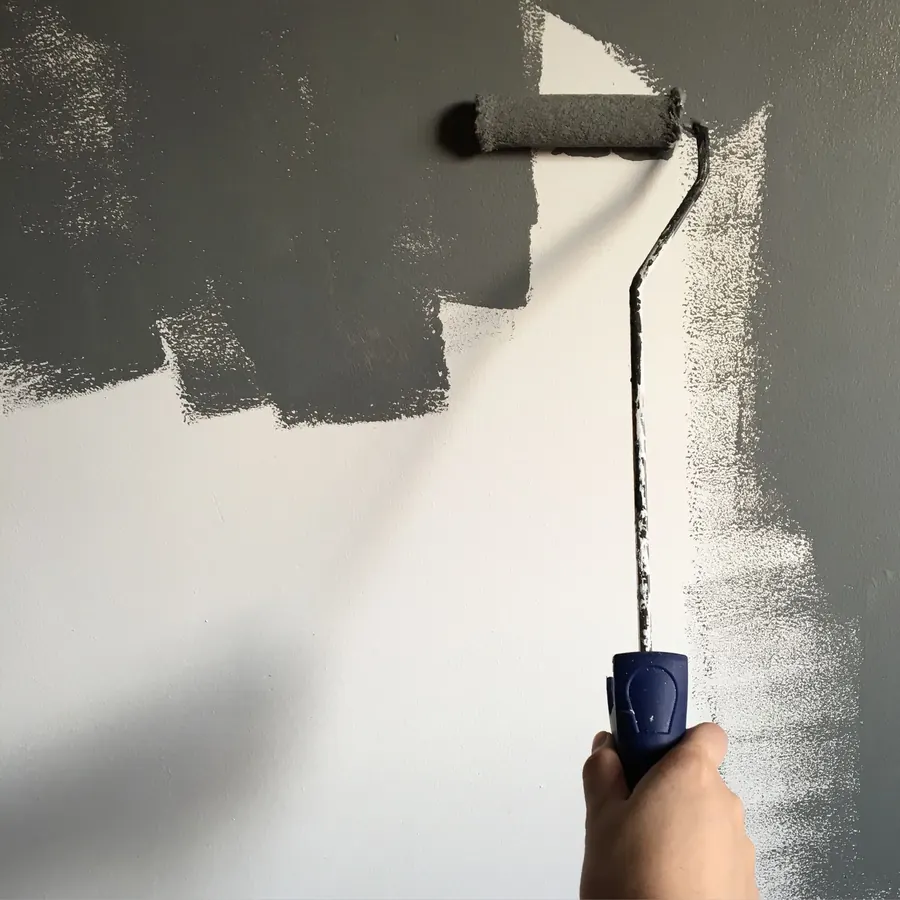
- A paint roller laying a stripe of dark grey paint over a white wall, with the white showing through thin areas. Photo: Stephanie Ho, via Pexels, Pexels License
- A roller on an extension pole applying orange paint to a brick wall beside a round metal vent. Photo: Michael Cory, via Wikimedia Commons, CC BY 2.0
Photos are resized and converted to WebP for this site; no other changes. Each remains under its original licence.
Related guides
Painting & Walls · Guide
2027 Color of the Year: Every Brand's Pick (and How to Actually Use It)
The 2027 color of the year depends on the brand: Celery, Grounded, Soulful Sage, Cottage Door, Artifact and more. Codes, rooms, sheens, pairings and how drenching changes gallons.

Painting & Walls · Guide
Can You Paint Over Wallpaper? When It Works and When to Strip It
Can you paint over wallpaper? Yes, if it's tight, smooth and not vinyl, and you seal it with an oil-based primer first. Here's the test, the steps, and when stripping wins.

Painting & Walls · Guide
How to Patch Drywall: Nail Pops, Dents and Fist-Size Holes
How to patch drywall by hole size: spackle for nail holes, a new screw for nail pops, tape for small holes, and a drywall plug for fist-size damage. Then prime.