PAINTING & WALLS GUIDE
Can You Paint Over Wallpaper? When It Works and When to Strip It
Can you paint over wallpaper? Yes, if it's tight, smooth and not vinyl, and you seal it with an oil-based primer first. Here's the test, the steps, and when stripping wins.
Can you paint over wallpaper? Yes, but only when the paper is stuck down tight, smooth, and not a heavy vinyl, and only after you seal it with an oil-based (alkyd) primer. Water-based paint or primer straight on paper can soften the paste and make it bubble or peel. If the paper strips off easily, strip it; it's usually less work than you think and the result is better.

Both big paint makers say they'd rather you didn't. Sherwin-Williams typically doesn't recommend it, and Benjamin Moore says even its most premium primer and paint won't hide wallpaper seams. That's the honest starting point: painting over paper is a workaround for walls where removal would do more damage than good, not a shortcut for every room. Even the data sheet for Zinsser's Cover Stain primer lists wallpaper among the things a surface should be free of before priming.
When painting over wallpaper works
Paint over it when the paper is well bonded everywhere, the surface is smooth, and removal is risky or miserable. This Old House gives two good reasons to leave paper on: it was hung straight onto unprimed drywall or plaster, so pulling it off would tear up the wall, or there are several layers stacked up, which makes stripping much harder.

Don't paint over it when:
| Wallpaper condition | Paint over it? | Why |
|---|---|---|
| Smooth, tight, no lifting seams | Yes, after oil-based primer | Best case; seams may still show faintly |
| Loose or peeling in several places | No, strip it | Paint adds weight and moisture to paper that's already letting go |
| Heavy vinyl or fabric-backed vinyl | No, strip it | Sherwin-Williams warns adhesion over heavy vinyl may be minimal; This Old House notes these usually peel off easily |
| High gloss or heavy texture | Strip it | Benjamin Moore singles out high-sheen and heavily textured paper; texture shows through |
| Paper hung on unprimed drywall | Often yes | Removal can tear the drywall face |
| Paintable wallpaper | Yes | It's made for it; Brewster, for example, sells expanded-vinyl paintable papers |
This Old House sums up a useful irony: papers that paint well tend to be hard to remove, and papers that don't paint well (vinyls) tend to come off easily. Its advice is to try peeling a small corner first and let that decide.
The 10-minute test before you commit
Pick a spot behind a door or a piece of furniture and pull at a corner of a strip. If it lifts in a full sheet or the top vinyl layer peels away cleanly, you've got your answer: strip the room.
If it won't budge, do a primer test. Sherwin-Williams' approach is to clean the area, lightly sand the seams, and brush on a quick-drying alkyd primer. If it dries without lifting or blistering, you can go ahead with the rest of the wall. If it bubbles, the paste is reactivating, and painting the whole room will only make a bigger version of that patch.
How to paint over wallpaper, step by step
1. Clean without soaking. This Old House recommends a barely damp cloth, or a diluted TSP solution on greasy kitchen walls, and warns against wetting the paper enough to soften the paste. Let the walls dry for at least 24 hours.
2. Fix seams and edges. Glue lifted seams back down with wallpaper seam adhesive, or cut away loose bits and fill the gap with spackle. Sand lightly once dry. If the paper has a texture you don't want to see, This Old House's painting contractors sand the whole wall with 120-grit and finish with 220.
3. Prime with an oil-based primer. This is the step people skip and regret. This Old House is blunt about it: whatever topcoat you plan, use an oil-based primer, because a water-based one can soak into the paper and loosen the adhesive. Cut in with a brush, roll the open wall, and ventilate well.
4. Paint. Two coats of your normal wall paint, more if you're covering a bold pattern or going light over dark.
Expect seams to remain faintly visible, especially in raking light from a window. Skim-coating the seams with joint compound and re-priming is the only real fix, and at that point you're close to the effort of stripping.
Worked example: a 12 × 14 ft bedroom
Walls are 8 ft high, with one door and two windows. Wall area is 52 ft × 8 ft = 416 sq ft. Taking off 20 sq ft for each standard door or window, the allowance Sherwin-Williams uses in its wall estimates, leaves 356 sq ft.
- Primer: Zinsser's technical data sheet for Cover Stain, a common oil-based primer, lists 400 sq ft per gallon on smooth, non-porous surfaces and 300 sq ft on rough, porous ones. Smooth, sealed paper sits closer to the first figure: 356 ÷ 400 = 0.9, so 1 gallon. It recoats in about 2 hours.
- Paint: two coats is 712 sq ft. At the 350 sq ft per gallon our paint calculator uses as its default, that's 2.03 gallons, so 2 gallons plus a quart. Check your paint's label rate and enter it in the calculator.
Compare that with stripping. Benjamin Moore puts wallpaper removal at one to two days of work for a standard 12 × 12 ft room, followed by priming. Painting over paper saves those days, but you trade them for seams you may still see.
If you strip it instead
Benjamin Moore's method: score the paper with a scoring tool, soak it with a remover (a store-bought gel, or homemade mixes such as one part fabric softener to three parts warm water, or one part vinegar to two parts water), wait 10 to 15 minutes while keeping it damp, then lift it with a rounded putty knife. Scrub off the remaining paste, sand rough spots with 220-grit, and let the wall dry.
Then prime before painting. Benjamin Moore recommends an oil-based primer after removal because it seals any paste you couldn't see. Where the drywall's paper face got torn, Sherwin-Williams has you remove the loose paper, sand the edges with 80 to 120 grit, seal the damaged areas with a drywall conditioner, and wait 3 hours before skim-coating, patching or priming.
Mistakes that ruin the job
Using latex primer on the paper. The water in it is exactly what loosens the paste. Seal with oil first; latex topcoats go on fine afterwards.
Painting over loose seams. Sherwin-Williams lists seams that won't lie down and blistering or peeling from the paint's moisture as the first problems with painting paper. A seam that's slightly lifted before you paint won't be fixed by paint.
Skipping the test patch. One square foot of primer behind the sofa tells you more than any guide.
Forgetting the next owner, who is often you. This Old House points out that painted-over wallpaper is harder to remove than unpainted paper, since the remover can't soak through the paint. If you'll want the paper gone in a few years, take it off now.
FAQ
Can you paint over wallpaper without primer?
Not reliably. Paint applied straight to paper can make it release from the wall, during painting or after, as Benjamin Moore warns. An oil-based primer seals the paper so the water in the topcoat can't reach the paste.
Can you paint over peel-and-stick or vinyl wallpaper?
Vinyl is the worst candidate. Sherwin-Williams notes that paint's adhesion over heavy vinyl may be minimal, and vinyl papers usually come off with a steady pull. Remove it. The exception is paper sold as paintable, which is designed to take paint.
Will the wallpaper seams show through paint?
Probably a little. Benjamin Moore says paint won't hide them. Sanding the seams and priming helps, and skim-coating them with joint compound is the only way to make them disappear.
What primer is best over wallpaper?
An oil-based (alkyd) primer. This Old House recommends it under any topcoat, and Sherwin-Williams suggests testing a quick-drying alkyd primer first. Whichever you buy, test it on a small patch before doing the room.
Planning to repaper rather than paint? How much wallpaper do I need walks through strips, rolls and pattern repeat. For coat counts and primer coverage on fresh drywall after stripping, see primer and how many coats of paint.
Sources
- Sherwin-Williams · Painting FAQs: Can I paint over wallpaper?
- Benjamin Moore · How to remove wallpaper in 6 steps
- This Old House · How to paint over wallpaper
- Rust-Oleum · Zinsser Cover Stain oil-based primer technical data sheet
- Sherwin-Williams · How to estimate how much wallpaper you need (20 sq ft per door or window)
- Brewster Wallcovering · paintable expanded-vinyl wallpaper specifications
Estimates and rules of thumb in these guides are for planning. Always confirm product coverage, local codes and supplier figures before you buy.
Image credits
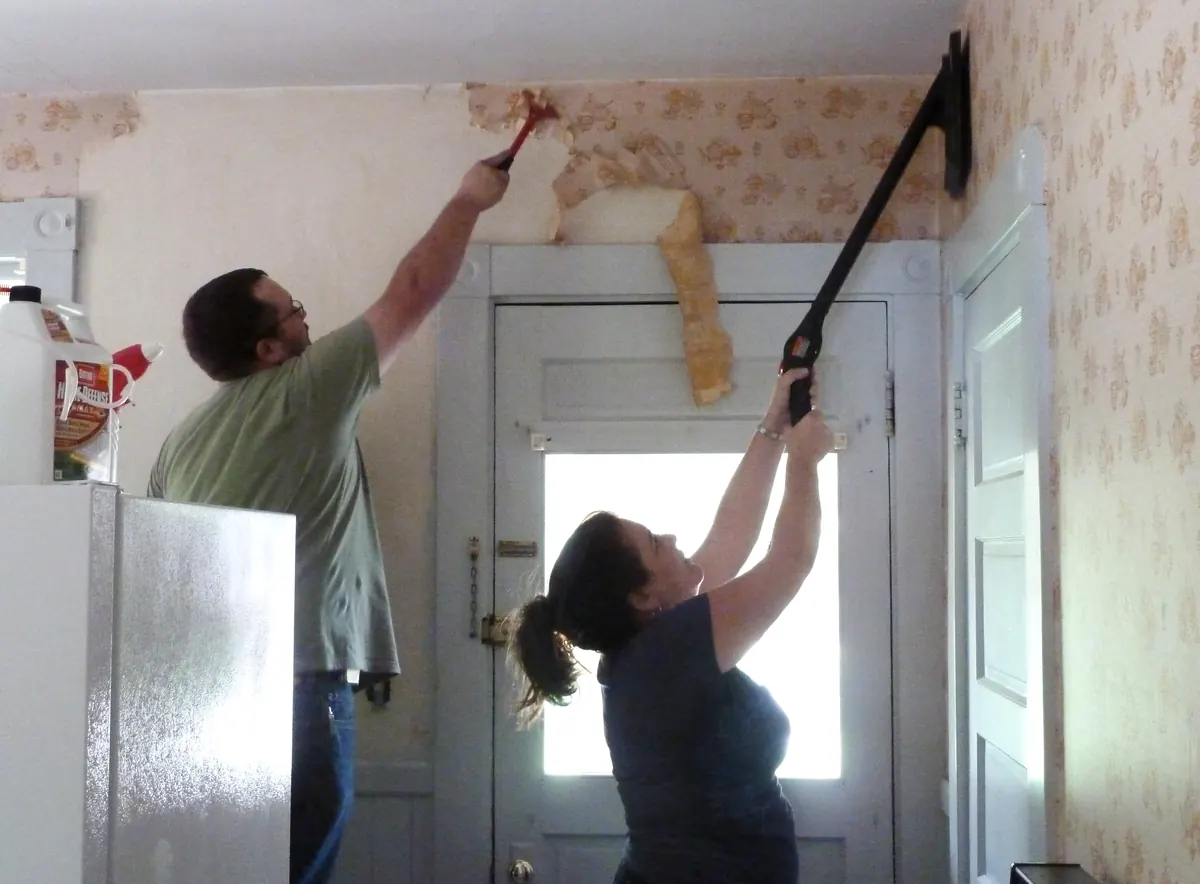
- Two people stripping old floral wallpaper above a kitchen door, one with a hand scraper and one with a long-handled tool. Photo: liz west, via Wikimedia Commons, CC BY 2.0
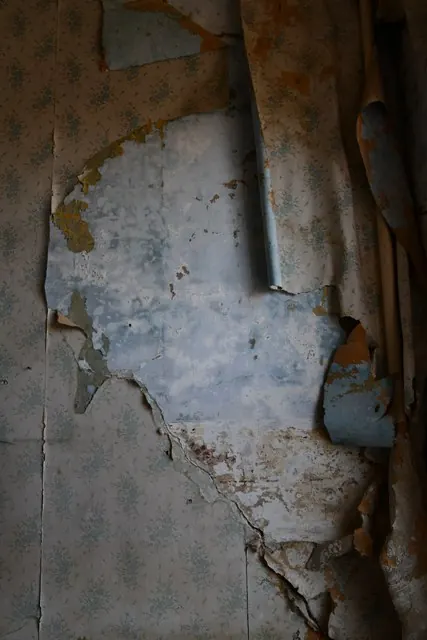
- Layers of old patterned wallpaper torn back on a wall, exposing older paper and bare plaster beneath. Photo: Michael Garlick, via Wikimedia Commons, CC BY-SA 2.0
Photos are resized and converted to WebP for this site; no other changes. Each remains under its original licence.
Related guides
Painting & Walls · Guide
How Long Does Paint Need to Dry Between Coats?
How long between coats of paint: 2 to 4 hours for latex wall paint, overnight for oil. Recoat times by product, primer, humidity and temperature, plus dry vs cure.
Painting & Walls · Guide
How Much Wallpaper Do I Need? Rolls, Strips and Pattern Repeat
How much wallpaper do I need? Count full-height strips, not square feet: strips around the room divided by strips per roll, with the pattern repeat added to every cut.
Painting & Walls · Guide
Primer and Number of Coats: How to Plan Your Paint Job
When you need primer and when you can skip it, how many coats each situation takes, primer coverage, and a worked new-drywall example with gallons for primer and paint.