KITCHEN & BATH GUIDE
Cabinet and Vanity Tariffs Double on January 1, 2027: Should You Buy Now?
Cabinet tariffs for 2027: the 25% duty on imported kitchen cabinets and vanities is set to hit 50% on Jan 1. What it really adds to a quote, how to spot imports and when ordering early pays.
ON THIS PAGE7 sections
The cabinet tariffs for 2027 are scheduled to double: imported kitchen cabinets, bathroom vanities and their parts have carried a 25% Section 232 tariff since October 14, 2025, and a presidential proclamation sets that rate to rise to 50% on January 1, 2027. If your remodel uses imported cabinets and you are ready to order, locking in the price and delivery this fall can save real money. If your cabinets are made in the U.S., or you are months from a final design, the deadline matters much less.
Everything here is as of October 2026. The increase was already postponed once (it was first set for January 1, 2026), so treat the date as scheduled, not certain, and recheck before you sign.
Cabinet tariffs 2027: what the rules actually say
The rules come from two proclamations under Section 232 of the Trade Expansion Act, a national-security trade law:
| What | Rule | Source |
|---|---|---|
| Kitchen cabinets and vanities | 25% from Oct 14, 2025 | Proclamation 10976 |
| Parts imported for cabinets and vanities | Same 25% (doors, boxes and other wood parts count) | Proclamation 10976 |
| Scheduled increase | 50% from Jan 1, 2027 (moved from Jan 1, 2026) | Proclamation 11000, 91 FR 1039 |
| European Union and Japan | Capped so the total duty does not exceed 15% | Proclamation 10976 |
| United Kingdom | Section 232 tariff capped at 10% | Proclamation 10976 |
| Softwood timber and lumber | 10% | Proclamation 10976 |
Customs (CBP) applies the cabinet duty to wooden kitchen cabinets, wooden vanities and their wooden parts under three tariff codes (9403.40.9060, 9403.60.8093 and 9403.91.0080). The Congressional Research Service notes the tariff applies on top of any antidumping, countervailing or Section 301 duties, and that there is no USMCA exemption, so Canadian and Mexican cabinets are covered too. Vietnam was the largest source of the upholstered furniture, cabinet and vanity imports covered, at about $4.5 billion of roughly $11 billion in 2024.
The date that matters is the customs date, not your order date. The rates apply to goods "entered for consumption" on or after the effective date. Cabinets an importer cleared through customs in 2026 and is holding in a U.S. warehouse already paid 25%. A special order that leaves an overseas factory in December and lands in January pays 50%.

What 25% to 50% does to a real cabinet quote
The tariff is charged on the import value: what the importer paid the overseas factory for the goods, not the price you see in the showroom. That is why a tariff that "doubles" doesn't double your cabinet bill.
Worked example: a mid-size kitchen of imported cabinets
Say a dealer imports a kitchen's worth of cabinet boxes and doors with a declared import value of $6,000, and before tariffs would have sold it to you for $12,000 installed-ready.
| At 25% | At 50% | Change | |
|---|---|---|---|
| Import value | $6,000 | $6,000 | |
| Section 232 duty | $1,500 | $3,000 | +$1,500 |
| Your price if the duty is passed through dollar for dollar | $13,500 | $15,000 | +$1,500 (about +11%) |
| Your price if the seller adds its usual markup on top of the duty | Higher | Higher still | Can be +$2,000 to +$3,000 |
So for this kitchen the step from 25% to 50% is worth roughly $1,500 to $3,000, about the price of a mid-range appliance. A small bathroom vanity scales down accordingly.
Two honest caveats. First, nobody can tell you exactly how much a given seller will pass through. NAHB's own explanation is that an importer can push some of the cost back onto the factory, absorb some in its margin, raise prices, or do a mix, though it says most of the cost usually reaches the end buyer. Second, the 25% that has applied since October 2025 is probably already in today's prices, so don't expect a 2027 quote to jump by the full new duty a second time.
Put both versions of the cabinet line into the renovation budget calculator and keep the difference as part of your contingency.
How to tell if your cabinets are imported
Most buyers have no idea, and showroom labels rarely say. Ask the dealer or contractor these questions in writing:
- Where are the cabinet boxes and the doors made? They can come from different countries. Imported parts are tariffed even if the cabinet is assembled in the U.S.
- Is this line stocked in a U.S. warehouse, or built to order overseas? Stocked imports already paid 25%; build-to-order imports could land after January 1.
- Is the current tariff already in this price, and what happens to my price if the rate changes before delivery?
- For vanities: is the vanity cabinet wood? The covered tariff codes are for wooden cabinets, vanities and parts. The countertop, sink and faucet are separate products under other rules.
As a rough guide, many stock and ready-to-assemble lines sold online and at big-box stores are imported, while made-to-order semi-custom and custom lines are more often built domestically. Confirm it for the exact line rather than assuming.

Ordering and delivery timing
If you have imported cabinets in your plan, here is how to use the next few weeks well:
- Finish the design first. A rushed order with the wrong sizes costs more than the tariff. Measure, settle the layout and the countertop footprint (the countertop calculator and our countertop measuring guide help).
- Ask for a ship date and a customs date, not just an order date. If the line is built overseas, the dealer should know when it clears U.S. customs.
- Get a fixed price in writing. The quote should say the price is locked when you pay the deposit, or spell out exactly how a tariff change would be passed on (an "escalation clause"). If it says nothing, assume the seller can pass the increase to you.
- Know the deposit and cancellation terms. Paying early to beat January only helps if you can live with the order.
- Store early deliveries properly. Cabinets delivered weeks before install need a dry, climate-controlled space, not a garage.
This is general information, not legal advice; read your own contract and ask the seller about anything unclear.
Alternatives if the numbers don't work
If a 2027 quote is too high, you don't have to replace every box:
- Paint the cabinets you have. The cheapest refresh by far. Use a cabinet-grade enamel in satin or semi-gloss; the paint calculator and our paint basics guide cover quantities and sheens.
- Reface or replace only the doors. Keep sound boxes and put new doors and drawer fronts on them. Ask where the new doors are made, since imported doors count as parts.
- Choose a domestic line. Domestic stock, RTA and semi-custom options exist at several price points; get one domestic quote next to any imported one.
- Keep the layout. Moving plumbing and appliances often costs more than the cabinets themselves. See how the money splits in our bathroom remodel cost breakdown.
- Buy stock sizes. Standard widths in stock lines cost less than custom sizes in any country.

Mistakes to avoid
- Assuming "Made in USA" on the box covers the doors. Imported parts are tariffed separately.
- Ordering in a panic. A design you are not sure of, ordered in October to save 10%, can cost far more to change later.
- Signing an open-ended quote. No price lock and no escalation clause usually means any increase lands on you.
- Budgeting the full 50% on the retail price. The duty is charged on import value, so double-counting will make a domestic quote look cheaper than it really is.
- Treating January 1 as final. The increase has been moved once already, and the proclamation exempts countries that reach a trade agreement on wood products. Recheck before you commit.
FAQ
Are cabinet tariffs going up in 2027?
Yes, unless the date moves again. Proclamation 11000 (91 FR 1039) sets the Section 232 tariff on imported kitchen cabinets, vanities and their parts to rise from 25% to 50% on January 1, 2027. EU and Japanese cabinets are capped at 15% total and UK cabinets at 10%.
Does the tariff apply to American-made cabinets?
No. It applies to imported cabinets, vanities and imported parts used to make them. A cabinet built in the U.S. from U.S. materials is not tariffed, although its maker may still raise prices if demand shifts toward domestic lines.
How much will a 50% tariff add to my kitchen?
The duty is charged on import value, not your retail price. For imported cabinets with a $6,000 import value, going from 25% to 50% adds $1,500 in duty, which might add roughly $1,500 to $3,000 to your price depending on how the seller marks it up.
Should I order cabinets before January 1, 2027?
Order early if your cabinets are imported, your design is final and the seller will put a locked price and delivery date in writing. It matters less for domestic lines or stock that is already in a U.S. warehouse, which cleared customs at the 25% rate.
Sources
- Proclamation 10976 · Adjusting Imports of Timber, Lumber, and Their Derivative Products (Sept 29, 2025; 90 FR 48127)
- Federal Register · Proclamation 10976 full text (Oct 6, 2025)
- Proclamation 11000 · Amendments delaying the increase to January 1, 2027 (Dec 31, 2025)
- Federal Register · Proclamation 11000, 91 FR 1039 (Jan 9, 2026)
- U.S. Customs and Border Protection · CSMS 66492057, Section 232 duties on timber, lumber and derivative products (HTS codes)
- Congressional Research Service · R48781, U.S.-Canada Softwood Lumber Trade (cabinet and vanity imports, stacking, USMCA)
- NAHB · How Tariffs Impact the Home Building Industry (25% on cabinets and vanities until Jan 1, 2027; who pays)
Estimates and rules of thumb in these guides are for planning. Always confirm product coverage, local codes and supplier figures before you buy.
Image credits
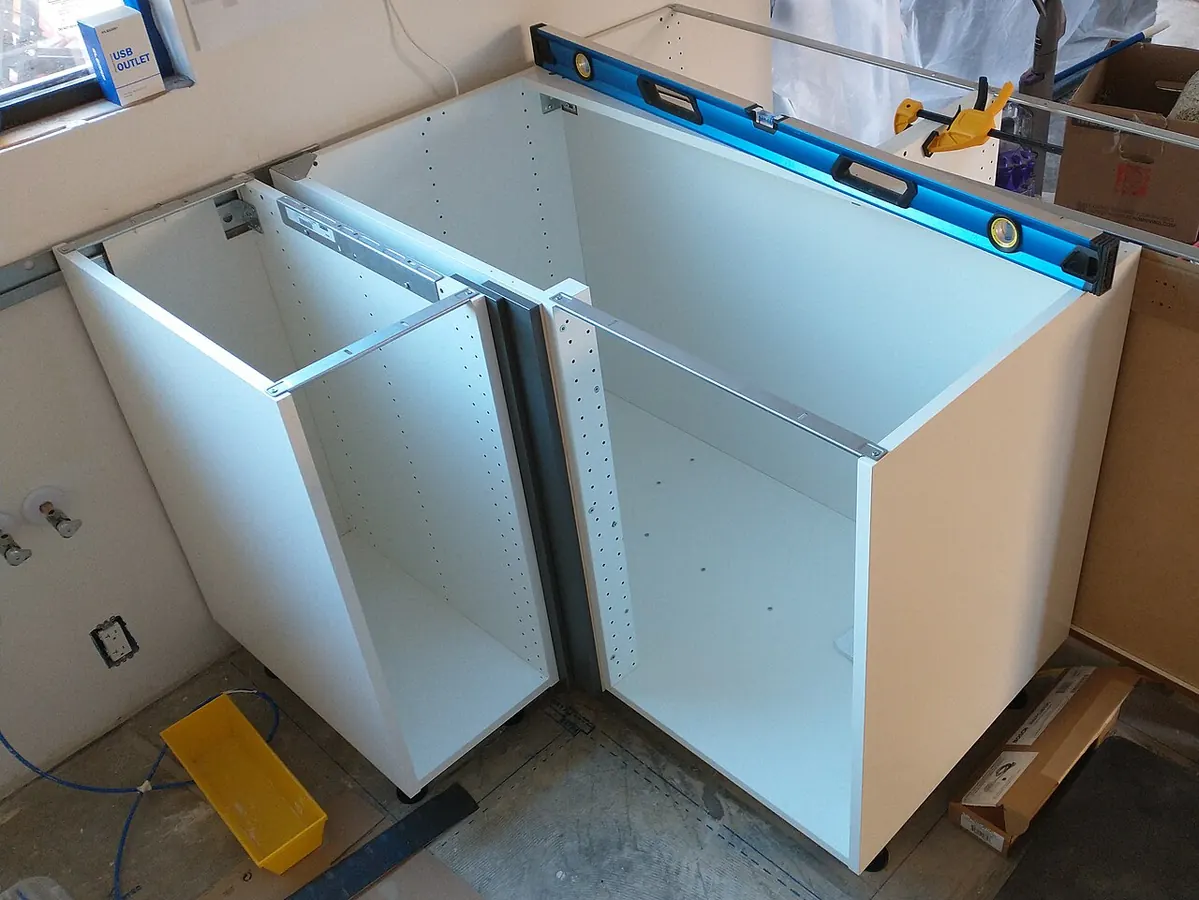
- Two assembled white flat-pack base cabinets, including a corner unit, set in a stripped kitchen with a level and clamps on top. Photo: Stilfehler, via Wikimedia Commons, CC BY-SA 4.0
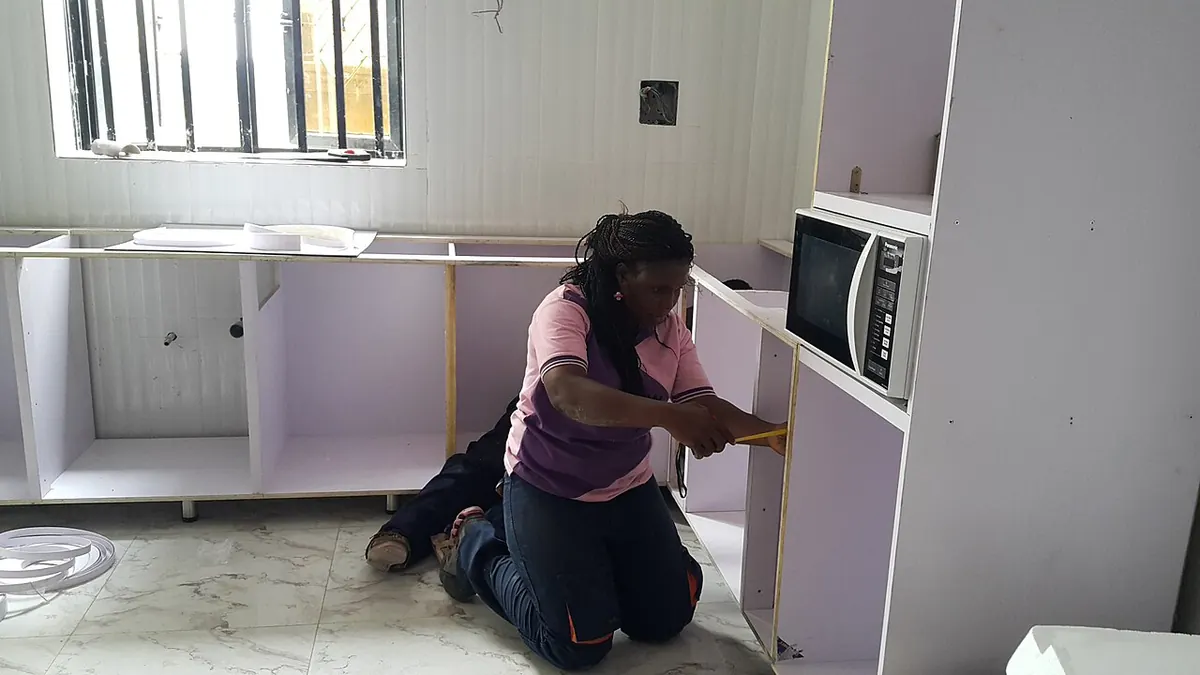
- A worker kneeling on a marble-look floor fitting a row of new base cabinets along a kitchen wall, with an upper cabinet and microwave beside her. Photo: Akpeski, via Wikimedia Commons, CC BY-SA 4.0
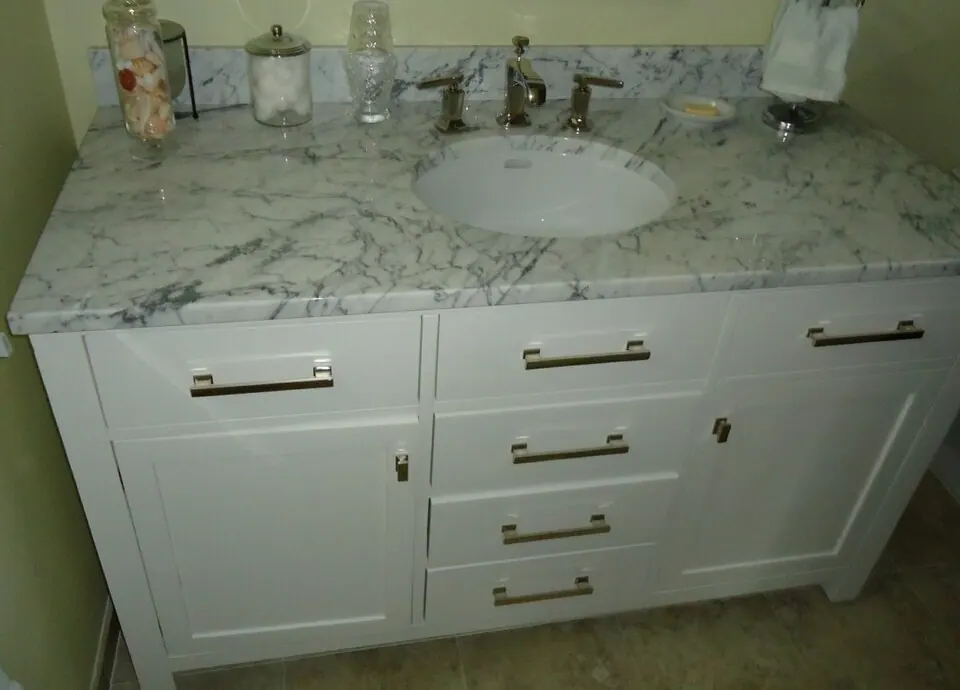
- A white shaker-style bathroom vanity with five drawers, two doors, brushed nickel pulls and a white marble top with an undermount sink. Photo: Tomwsulcer, via Wikimedia Commons, CC0
Photos are resized and converted to WebP for this site; no other changes. Each remains under its original licence.
Related guides
Kitchen & Bath · Guide
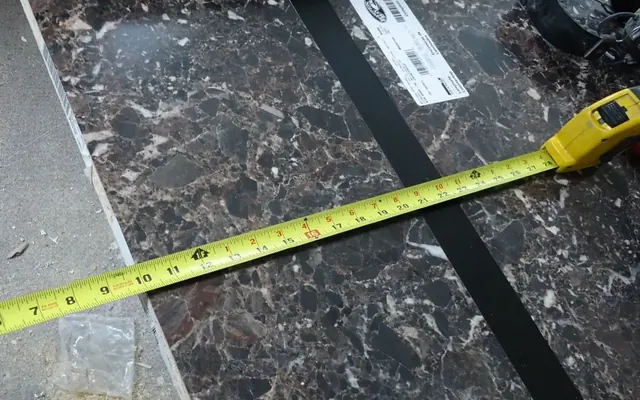
How to Measure Countertops in Square Feet (L-Shapes, Islands and Backsplash)
How to measure countertops in square feet: length × depth in inches ÷ 144 per section, the L-shape corner trap, islands with seating, and a 4 in backsplash, with a worked example.

Kitchen & Bath · Guide
Bathroom Remodel Cost Breakdown: Where the Money Actually Goes
A bathroom remodel averages about $12,000, and roughly half is labor. See the line-by-line split, labor by trade, and the three choices that move the total most.
Around the World · Essay
How Homes Are Renovated in Germany: Renters Bring Their Kitchen, Solid Masonry and Strict Trades
How Germans really renovate: tenants who take their own kitchen, courts that limit repainting clauses, licensed trades, and what a bathroom costs. Ideas to borrow.