PAINTING & WALLS GUIDE
How Much Wallpaper Do I Need? Rolls, Strips and Pattern Repeat
How much wallpaper do I need? Count full-height strips, not square feet: strips around the room divided by strips per roll, with the pattern repeat added to every cut.
How much wallpaper do I need? For a typical 12 × 14 ft bedroom with 8 ft ceilings, plan on about 11 double rolls of standard 20.5 in × 33 ft paper. The reliable way to get your own number is to count strips, not square feet: work out how many full-height strips go around the room, how many of those strips you can cut from one roll once the pattern repeat is added, and divide.
Square-foot math alone is how people end up a roll or two short. A double roll holds about 56 sq ft of paper, but every strip loses a few inches to trimming and up to a full pattern repeat to lining up the design, and the leftover end of each roll is usually too short to use.
How much wallpaper do I need: the strip method
You need four numbers: the distance around the room, the wall height, the roll width and length, and the pattern repeat printed on the label.
- Strips around the room. Measure each wall corner to corner, add them up, and divide by the roll width. Round up. James Dunlop, a wallcovering maker, says to count part-widths as full widths, because you only wrap 2 to 3 cm into a corner and start the next wall with a fresh strip.
- Length of each strip. Wall height, plus trim, plus the pattern repeat. York Wallcoverings allows about 4 in (2 in at the ceiling, 2 in at the baseboard) for trimming. Dunlop allows a more generous 15 cm at each end.
- Strips per roll. Divide the roll length by the strip length and round down. A partial strip is scrap.
- Rolls. Strips needed divided by strips per roll, rounded up.

Plain, textured and random-match papers skip the repeat in step 2. Dunlop notes that free-match and reverse-hung papers don't need it, which is why they're the cheapest papers to hang in terms of roll count.
Pattern repeat: where the extra rolls come from
The repeat is the vertical distance before the design starts again. To make strip two line up with strip one, you have to start each cut at the same point in the pattern, and whatever you cut off to get there is waste.

Here is what that does to a standard 33 ft (396 in) double roll, using wall height + 4 in trim + the full repeat for each strip:
| Ceiling height | No repeat | 12 in repeat | 21 in repeat | 25 in repeat |
|---|---|---|---|---|
| 8 ft | 3 strips | 3 strips | 3 strips | 3 strips |
| 9 ft | 3 strips | 3 strips | 2 strips | 2 strips |
| 10 ft | 3 strips | 2 strips | 2 strips | 2 strips |
Look at the 9 ft row. A 21 in repeat makes each strip 133 in, and three of those need 399 in, 3 in more than the roll holds. You drop from three strips per roll to two, and the room needs nearly 50 percent more paper. That cliff is the single biggest reason wallpaper estimates go wrong, and it's invisible if you only work in square feet.
Farrow & Ball sees the same pattern on its 10 m × 53 cm rolls in a standard 2.4 m room: roughly four drops per roll for stripes, three for small repeats, and two for large repeats.
A worked example
A 12 × 14 ft bedroom, 8 ft ceilings, one door, two windows, and a paper with a 21 in repeat on a 20.5 in × 33 ft double roll.
- Around the room: 12 + 14 + 12 + 14 = 52 ft, which is 624 in. Divided by 20.5 in, that's 30.4, so 31 strips.
- Strip length: 96 in + 4 in + 21 in = 121 in.
- Strips per roll: 396 ÷ 121 = 3.27, so 3 strips.
- Rolls: 31 ÷ 3 = 10.3, so 11 double rolls.
The same room with 9 ft ceilings drops to two strips per roll and needs 16 double rolls. With a plain paper at 9 ft, it's back to 11.
As a cross-check, Sherwin-Williams' square-foot method takes wall area (52 × 8 = 416 sq ft), subtracts 20 sq ft per standard door or window (60 sq ft here), and divides by a usable yield per single roll that shrinks with the repeat: 25 sq ft for 0 to 6 in, 22 for 7 to 12 in, 20 for 13 to 18 in and 18 for 19 to 23 in. That gives 356 ÷ 18 = 19.8, so 20 single rolls, which is 10 double rolls. The strip count says 11. When the two methods disagree, trust the strip count; it's built from the cuts you'll actually make.
The wallpaper calculator runs the strip method for you, including the repeat and trim, and lets you subtract openings by area.
Doors, windows and odd walls
Don't subtract much. Dunlop recommends treating walls with doors and windows as full walls, since you use nearly as much paper cutting and piecing around an opening as you would on a plain drop. Sherwin-Williams does subtract openings at 20 sq ft each, but its usable-yield figures are already conservative. A fair rule: leave ordinary doors and windows in the count, and take out strips only for a wide opening such as a sliding patio door or an archway with no wall above it.
Count short areas (above a door, below a window, over a radiator) as part of the room's strip total rather than trying to save on them. Those pieces often come out of offcuts, and that's the margin that keeps you from reordering.

Accent walls work the same way. A 12 ft wall is 144 in ÷ 20.5 in = 7.02, so 8 strips. At 8 ft with a 21 in repeat that's three per roll, so 3 double rolls. That 0.02 is worth noticing: measure carefully, because a quarter inch can add a strip.
Mistakes that cost a second order
Dividing wall area by 56 sq ft. That's the paper on the roll, not the wall it covers. On a patterned paper with a tall ceiling, you can lose a third of the roll to offcuts.
Ignoring the run number. Sherwin-Williams points out that wallpaper is printed in batches whose colour varies slightly but noticeably, so every roll should carry the same run or lot number. Buy everything in one order.
Adding a waste percentage on top of the strip count. The strip method already includes trim and pattern-match waste. Dunlop does suggest adding 10 percent when you're working from an estimate, and 15 to 20 percent for repeats over 26 cm, but don't stack it on a strip count. Add one spare roll instead, for mistakes and future repairs, which is what Farrow & Ball and Sherwin-Williams both suggest.
Confusing single and double rolls. In the US, paper is often priced per single roll but sold only in double (or triple) rolls. Sherwin-Williams' example of 20 single rolls means 10 double rolls at the counter.
FAQ
How many rolls of wallpaper for a 10 × 12 room?
With 8 ft ceilings: 44 ft around the room is 528 in, which is 26 strips of 20.5 in paper. At three strips per 33 ft roll, that's 9 double rolls, plus one spare. With a large repeat and 9 ft ceilings (two strips per roll), it's 13.
How many square feet does a roll of wallpaper cover?
A standard US double roll, 20.5 in wide and 33 ft long, holds about 56 sq ft of paper. Usable coverage is lower. Sherwin-Williams' planning figures run from 25 sq ft per single roll (50 per double) for small repeats down to 18 sq ft per single roll (36 per double) for repeats of 19 to 23 in.
Should I subtract doors and windows?
Only wide openings. Normal doors and windows still need cut pieces above and below them, and the paper saved is small. Leaving them in gives you a built-in buffer.
Do I need extra wallpaper for a drop match?
Use the full repeat in your strip length, as the label states it, and you're covered for straight and drop matches alike. The label also tells you which match the paper uses, so check it before you cut the first strip.
Once you've ordered, you may be prepping walls that already have paper on them; see whether you can paint over wallpaper for when old paper has to come off first. If you're comparing a papered wall with a painted one, how much paint for a room works through the same room in gallons.
Sources
- Sherwin-Williams · How to estimate how much wallpaper you need
- James Dunlop Textiles · How to calculate wallpaper requirements
- Farrow & Ball · Calculating wallpaper quantities
- York Wallcoverings · Installation guide (trim allowance)
- Brewster Wallcovering · product specifications (20.5 in × 33 ft roll, about 56 sq ft)
Estimates and rules of thumb in these guides are for planning. Always confirm product coverage, local codes and supplier figures before you buy.
Image credits
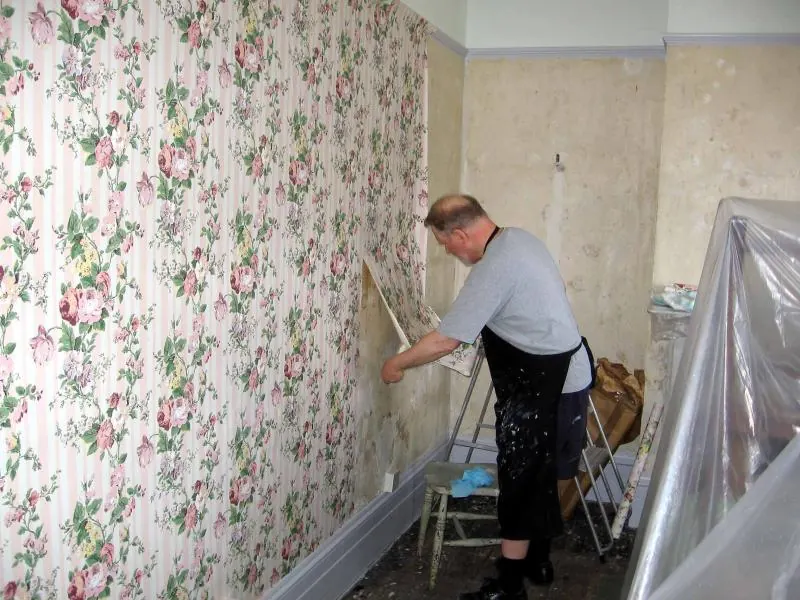
- Man smoothing a floral striped wallpaper strip into place beside a bare plaster wall still to be covered. Photo: Rictor Norton & David Allen, via Wikimedia Commons, CC BY 2.0
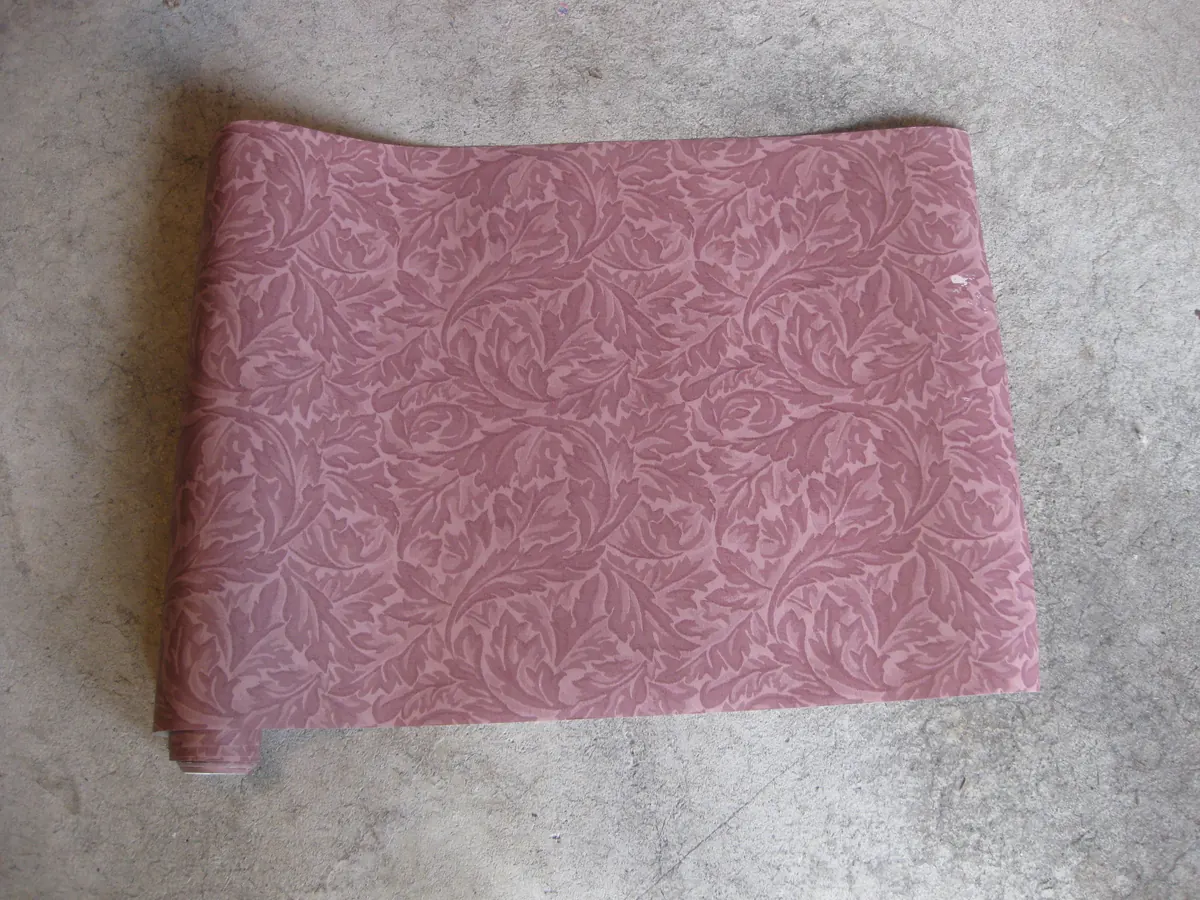
- Roll of mauve wallpaper with a repeating leaf pattern partly unrolled on a concrete floor. Photo: Thekohser, via Wikimedia Commons, CC BY-SA 3.0
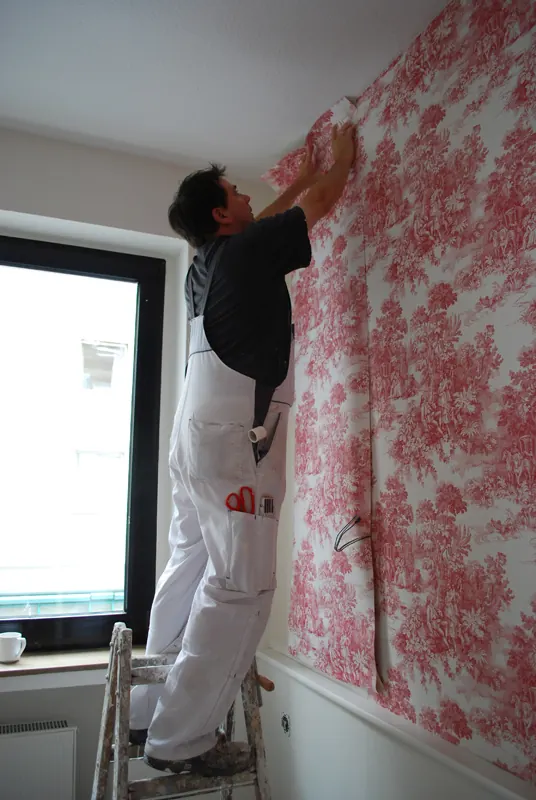
- Decorator on a stepladder pressing a red toile wallpaper strip into place at the ceiling line. Photo: Hotel Domspitzen Köln, via Wikimedia Commons, CC BY-SA 2.0
Photos are resized and converted to WebP for this site; no other changes. Each remains under its original licence.
Related guides
Painting & Walls · Guide
Can You Paint Over Wallpaper? When It Works and When to Strip It
Can you paint over wallpaper? Yes, if it's tight, smooth and not vinyl, and you seal it with an oil-based primer first. Here's the test, the steps, and when stripping wins.
Painting & Walls · Guide
How Many Sheets of Drywall Do I Need for a Room?
How many sheets of drywall do I need? For 8 ft walls, perimeter ÷ 4 gives 4×8 sheets, plus ceiling area ÷ 32, plus 10 to 15 percent. Worked examples inside.

Around the World · Essay
How Homes Are Renovated in South Korea: Ondol Floors, Apartment Rules and Wallpaper Everywhere
How South Korean apartments are really renovated: ondol heated floors, management-office consent, who does the work, what a full remodel costs, and ideas to borrow.