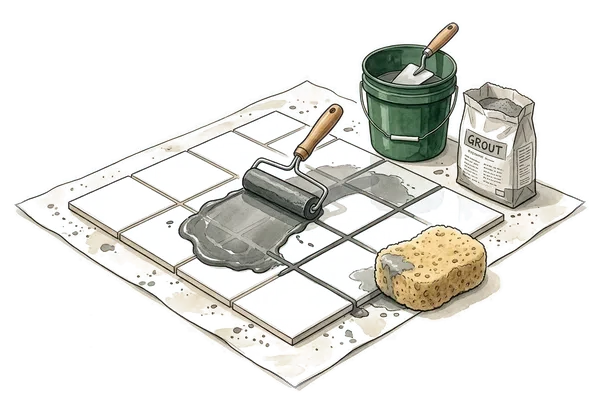
THE MATH, MADE VISIBLE
How it works
Grout fills the joints, so the amount follows the joint volume. For tile length L and width W, the joint length per unit of area is (L + W) ÷ (L × W). Joint volume = area × joint width × tile thickness × (L + W) ÷ (L × W). Pounds = volume × grout density. Planned pounds = pounds × (1 + allowance ÷ 100). Bags = round up(planned pounds ÷ bag size).
Real project examples
A 12 × 12 in tile bathroom floor
80 ft² of 12 × 12 × 3/8 in tile with a 1/8 in joint: (1 + 1) ÷ (1 × 1) = 2 ft of joint per ft², so the joints hold 80 × (1/96 ft) × (1/32 ft) × 2 = 0.052 ft³ (90 in³). At 110 lb/ft³ that is 5.73 lb; with 10% extra, 6.3 lb. One 25 lb bag covers it, about 349 ft² per bag at this joint.
A 6 × 24 in plank-tile floor
200 ft² of 6 × 24 × 3/8 in tile with a 3/16 in joint: (2 + 0.5) ÷ (2 × 0.5) = 2.5 ft of joint per ft², so the joints hold 0.244 ft³. At 110 lb/ft³ that is 26.9 lb; with 10% extra, 29.5 lb. Buy 2 bags of 25 lb. At $28 per bag, $56.
Before you buy
- MAPEI describes its grout calculator as based on the actual volume to be filled and the product density. This calculator uses the same joint-volume method so you can see each step.
- The 110 lb/ft³ default is our calculation, not a manufacturer’s number: it is the density that reproduces Custom Building Products’ chart for Polyblend Plus Sanded Grout (348 ft² per 25 lb for 12 × 12 × 3/8 in tile with a 1/8 in joint). Other grouts weigh differently, so check the coverage chart for the grout you buy.
- Use the actual tile thickness, not the nominal size. Thicker tile means deeper joints and more grout, even when the face size is the same.
- Use the joint width your tile and installer call for. Joint width changes grout volume in direct proportion, so a 1/4 in joint needs twice the grout of a 1/8 in joint.
- MAPEI recommends adding 5% to 10% overage so the whole project is covered. The default is 10%; small mosaics and uneven tile can need more.
- The type of grout matters as well as the amount. Sanded and unsanded grouts have different joint-width ranges; check the bag for the joints it is rated for.
Questions worth asking
How much grout do I need per square foot?
It depends on tile size, thickness and joint width. For 12 × 12 × 3/8 in tile with a 1/8 in joint, the calculator gives about 0.07 lb per ft², or roughly 349 ft² per 25 lb bag at the 110 lb/ft³ default. Small tile and wide joints use far more.
Why does small tile need so much more grout?
Smaller tiles mean more joint length per square foot. A 12 × 12 in tile has 2 ft of joint per ft²; a 2 × 2 in mosaic has 12 ft of joint per ft², six times as much at the same width and depth.
Where does the density come from?
It is an editable input. The default of 110 lb/ft³ is worked back from Custom Building Products’ published coverage for Polyblend Plus Sanded Grout. If your grout’s chart gives a coverage, adjust the density until the calculator matches it.
Does this work for premixed or epoxy grout?
Only if you enter a matching density and package size. Premixed and epoxy grouts are often sold by volume or in kits, so the manufacturer’s own coverage chart is the better guide.
Sources & assumptions
MAPEI · grouts calculator (joint volume × product density)MAPEI · tile grouts calculator (5–10% overage)Custom Building Products · grout coverage chartsNIST · unit conversion factorsLast reviewed October 1, 2026. Planning defaults are editable examples. Product labels and supplier information override them.